The Importance of Shirt Quality and Logistics Processes in Export
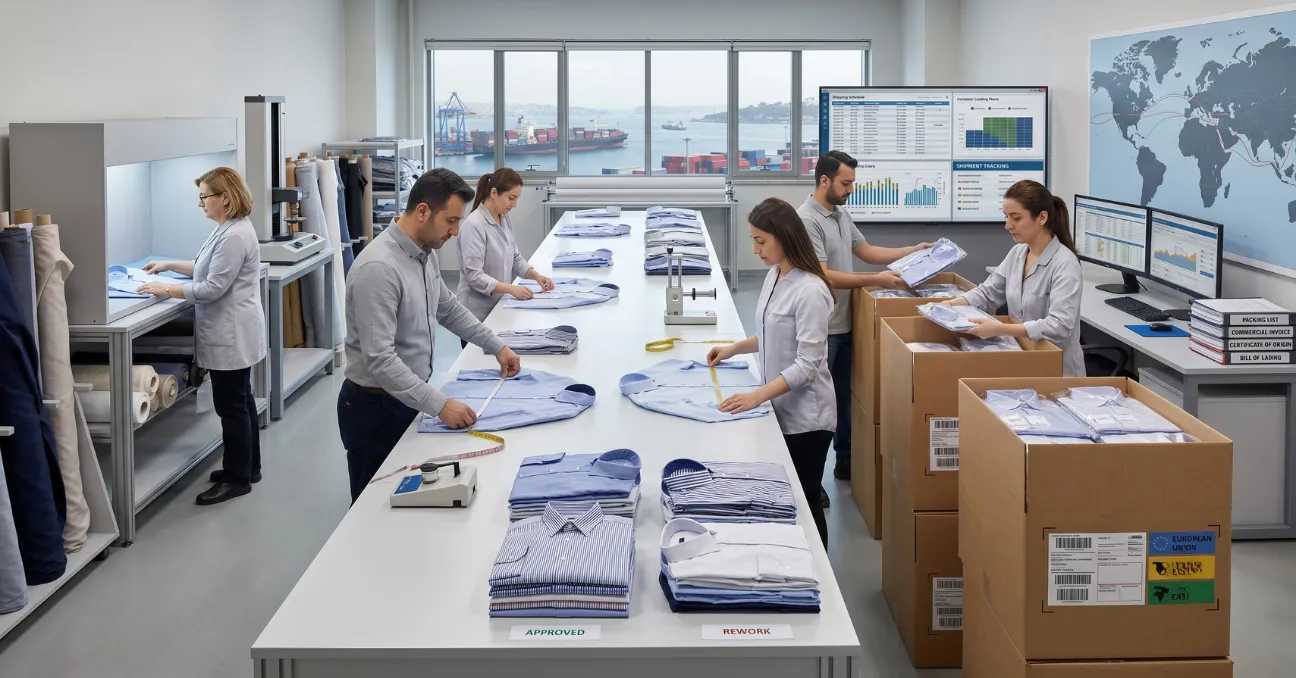
In international shirt production, export success depends on more than manufacturing capacity alone. Product quality, logistics planning, packaging standards, delivery timing, documentation accuracy, sustainability expectations, and buyer-specific requirements all shape the final customer experience.
For global buyers, wholesalers, private label brands, and corporate clients, shirt export logistics and quality processes must work together. A well-made shirt loses value if it arrives late, damaged, wrinkled, incorrectly packed, or without the required export documents. This is why quality control and logistics should be planned as one integrated export strategy.
1. Core Quality Components in the International Shirt Market
In shirt export logistics and quality management, product quality is not limited to fabric selection. Reaching strong international standards requires the combination of fabric quality, stitching workmanship, fit accuracy, color fastness, durability, finishing quality, and packaging discipline.
For example, quality tests carried out in modern production facilities in Istanbul can help improve a shirt’s competitiveness in international markets. Before export, each shirt should be evaluated not only as a textile product but also as a finished garment that must meet the expectations of the target market.
Key quality components include fabric consistency, correct measurements, collar and cuff construction, button strength, seam durability, ironing quality, and final appearance. These details directly affect buyer satisfaction and repeat order potential.
2. Quality Control at Every Stage of Production
Quality control should not be limited to the final inspection stage. In export-oriented shirt production, quality must be monitored from fabric inspection to cutting, sewing, finishing, ironing, packaging, and shipment preparation.
Fabric should be checked for micro-level defects, color variation, shrinkage behavior, and surface consistency. Stitching should be tested for strength and alignment. Finished shirts should be reviewed for fit, comfort, appearance, and wearability.
Akçınar Giyim’s shirt product groups page shows the production flow from R&D, design, sample and cutting to sewing, quality control and packaging, making it a relevant reference point for buyers reviewing production capabilities.
3. Logistics Planning in Shirt Export Operations
In export operations, logistics is not only about moving products from one country to another. It also includes delivery planning, packaging standards, customs preparation, shipment method selection, cost control, and communication with the buyer.
Shirts leaving production facilities in Istanbul must be protected before shipment. Proper folding, packing, box selection, humidity control, and shipment labeling can reduce the risk of damage or wrinkling during transit.
For example, when exporting shirts to a European country, special boxes, protective inner packaging, and humidity-balancing materials may be used to keep shirts in better condition during transport. These details help strengthen trust between the supplier and the buyer.
4. Packaging Standards for Export Shirts
Packaging plays a critical role in shirt export logistics and quality. A high-quality shirt must reach the buyer in a clean, well-presented, and sellable condition. Poor packaging can damage product perception even when the garment itself is well made.
Export packaging should consider folding method, polybag quality, carton strength, product labels, size breakdowns, barcode systems, and buyer-specific packaging instructions. For private label orders, packaging may also include brand labels, hang tags, special boxes, stickers, or custom presentation materials.
When packaging standards are defined clearly before production, shipment errors and post-delivery complaints can be reduced.
5. Customs Documentation and Delivery Accuracy
Customs processes are one of the most important stages of international shirt export. Missing, incorrect, or delayed documents can create delivery problems and increase costs for both supplier and buyer.
Export documentation may include commercial invoices, packing lists, certificates of origin, transport documents, product details, and buyer-specific compliance documents. These should be prepared accurately before shipment.
Fast and error-free customs preparation helps shorten delivery time and reduces operational risk. For international buyers, this level of organization is often as important as the product itself.
6. Sustainability and Quality in Shirt Export
Sustainability has become an increasingly important factor in the fashion and textile industry. In shirt export logistics and quality strategies, sustainable material use, responsible production, energy efficiency, and recyclable packaging can strengthen brand value.
For example, using certified organic cotton, improving energy efficiency in production facilities, reducing waste, and choosing recyclable packaging materials can support sustainability goals. These practices are especially valuable in European and North American markets where buyers may have stronger compliance and sustainability expectations.
Logistics can also support sustainability. Optimized routes, efficient shipment planning, and reduced packaging waste can help lower the environmental impact of export operations.
7. Practical Quality Control Checklist Before Export
To reduce export risks, manufacturers and buyers should use clear quality control checklists before shipment. This helps identify potential problems before products leave the facility.
- Final fabric and stitching quality checked
- Measurements and fit verified according to buyer specifications
- Color consistency and color fastness reviewed
- Button, collar, cuff and seam strength inspected
- Ironing and final finishing completed
- Packaging standards confirmed
- Size and color breakdowns matched with order details
- Export labels, barcodes and documents prepared
- Shipment route and transport conditions confirmed
8. Logistics Scenarios for International Shirt Buyers
Different export destinations may require different logistics strategies. Air freight can be preferred for urgent shipments, seasonal launches, or time-sensitive retail orders. Sea freight may be more cost-effective for larger volumes and planned deliveries.
For European buyers, shorter transit times from Türkiye can offer an operational advantage. For long-distance markets, packaging strength, transit protection, and documentation accuracy become even more important.
Maintaining clear communication with the buyer throughout the logistics process increases transparency. Shipment updates, document sharing, packing list confirmation, and delivery tracking help build long-term trust.
9. Understanding International Buyer Expectations
International buyers may have different quality and logistics expectations depending on their market. Some European buyers may prioritize certifications, technical documentation, and sustainability standards. Middle Eastern buyers may focus more on fast delivery, flexibility, and product availability. North American buyers may require detailed compliance and packaging specifications.
Exporters must analyze each buyer’s expectations carefully. Production standards, packaging instructions, logistics flexibility, and documentation requirements should be aligned before the order begins.
Akçınar Giyim supports buyers with custom design and private label production capabilities, helping brands respond to market-specific requirements more efficiently. Product test reports, quality documents, and clear production follow-up can help increase buyer confidence.
10. Why Quality and Logistics Should Be Managed Together
In shirt export, quality and logistics are closely connected. Even if the shirts are produced with strong workmanship, poor logistics planning can damage the final result. Similarly, fast delivery does not create value if the products fail to meet buyer expectations.
For this reason, successful export management requires an integrated approach. Fabric selection, production quality, packaging, customs documentation, shipment planning, and buyer communication should be coordinated from the beginning of the project.
In Summary: Export Success Depends on Quality, Planning and Trust
Shirt export logistics and quality processes directly affect international buyer satisfaction. Product quality, packaging, delivery accuracy, sustainability practices, documentation, and logistics planning all contribute to a stronger export operation.
With experienced production capabilities, quality-focused workmanship, and organized export planning, Akçınar Giyim helps international buyers access reliable shirt manufacturing solutions from Türkiye. A well-managed export process supports not only product delivery but also long-term brand trust and global market success.
Similar Blogs

How Can You Tell a Quality Men's Shirt?
In menswear, shirts are among the most frequently preferred garments for both everyday wear and business life. However, not every shirt has the same level of quality. Many elements, from the fabric structure and stitching details to the fit and collar shape, determine the quality of a men's shirt. Therefore, when choosing a shirt, it is important to consider not only its color and style but also the details that indicate production quality.
READ MORE
Important Factors Affecting Costs When Buying Wholesale
When buying wholesale, material quality is one of the most important factors determining costs. Cotton, polyester, and blended fabrics each have a different pricing level. For example, although high-quality cotton fabrics are more durable and comfortable, they place direct upward pressure on costs. The quality of the yarn used and the weaving density are also among the technical details that affect the price.
READ MORE
Details to Keep in Mind Before Placing a Custom Design Orde
Before placing a custom design order, the first step is to fully define the expectations related to the product. Determining elements such as fabric quality, color palette, cut details and intended use in detail helps prevent misunderstandings that may arise during the production process. Technical drawings or sample requests shared with the supplier are critical for ensuring that the order is understood correctly. At this stage, originality and functionality should be balanced by considering fashion trends and the demands of the target audience.
READ MORE
Key Factors Affecting Prices in Wholesale Purchasing and Common Cost Mistakes
Wholesale price factors play a critical role in purchasing decisions for fashion brands, retailers, boutique sellers, private label companies and corporate buyers. In bulk purchasing, the final price is not shaped only by the product itself; fabric quality, workmanship, production planning, logistics, order volume and market dynamics all influence the total cost.
READ MORE
5 Key Factors Affecting Costs in Bulk Men's Shirt Production
Cost calculations in high-volume men’s shirt production form the foundation of purchasing strategies for wholesalers, boutique sellers, private label brands and corporate buyers. Understanding the main factors that influence bulk production costs helps businesses manage budgets more accurately while protecting product quality.
READ MORE
Critical Elements You Need to Know for Successful Export in the European and U.S. Textile Markets
Exporting textile products to Europe and the United States requires more than production capacity and competitive pricing. Each market has its own consumer expectations, legal requirements, certification standards, logistics dynamics and brand communication habits.
READ MORE
Critical Considerations in the Wholesale Shirt Purchasing Process
Buying shirts in bulk is not only about choosing models and comparing prices. For retailers, wholesalers, corporate buyers and private label brands, the success of a shirt order depends on fit selection, fabric quality, cost planning, color variety, delivery reliability, quality control and after-sales support.
READ MORE
How Is the Quality Control Process Managed in Bulk Shirt Orders?
In bulk shirt orders, ensuring that every product carries the same quality standard is just as important as delivering the order on time. Small differences in a few pieces may create a limited issue in individual sales, but in production volumes of hundreds or thousands of shirts, these differences can turn into serious costs.
READ MORE
The Details of Quality Control Process with Akçınar Giyim in Bulk Shirt Orders
Akçınar Giyim approaches bulk shirt order quality control as a structured process that begins before production and continues until final shipment. By defining clear standards, approving samples and inspecting production stages, businesses can reduce the risk of inconsistent products, customer complaints and delivery problems.
READ MORE
Classic and Slim Fit Men's Shirts The Details of Choosing the Right Cut for Your Brand
Choosing between classic fit and slim fit men’s shirts is an important decision for brands that want to build a strong product identity and meet the expectations of their target customers. Shirt fit affects not only appearance, but also comfort, customer satisfaction, sales performance and brand positioning.
READ MORE